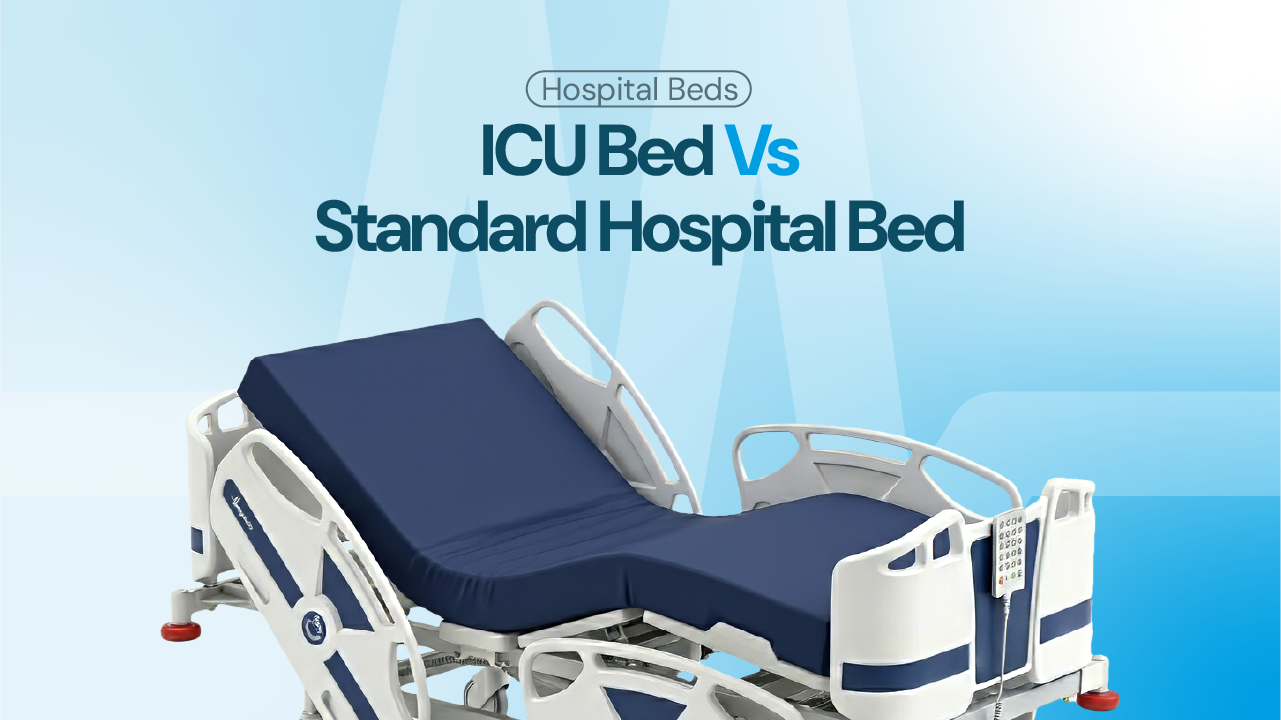
In healthcare institutions, the standards of medical equipment on which patients spend their recovery period are one of the most fundamental elements determining the quality of treatment. Frequently compared in clinical settings, an ICU bed vs standard bed should be evaluated not merely as physical resting places, but as medical devices that directly participate in the therapeutic process. For critically ill patients, the bed is not a passive piece of furniture; it is an active treatment platform that supports respiratory, circulatory, and tissue integrity. Selecting the correct equipment minimizes the risk of complications while significantly accelerating the patient’s path to discharge.
The Role of Medical Equipment in the Healing Process
A patient becoming fully or partially bedridden is contrary to the normal functioning of human anatomy. Immobility brings about secondary health issues such as muscle atrophy, circulatory disorders, and reduced respiratory capacity. At this point, the quality of the surface the patient is resting on and its positioning capabilities come into play. Advanced medical beds aim to reduce stress on organs and support the circulatory system by mimicking the body’s natural physiological needs.
Matching Equipment Selection to Clinical Needs
For patients treated in general wards with partially maintained mobility, standard hospital beds can provide sufficient ergonomics. However, for patients whose vital functions are at risk, who require respiratory support, or who are unconscious, standard equipment falls short. Since the intensive care environment requires continuous observation and immediate intervention, the beds used in these units are expected to function as an extension of the medical team. The bed’s mobility, surface technology, and emergency integrations are the dominant factors determining the patient’s chances of survival and treatment comfort.
Key Functional Distinctions Between an ICU Bed vs Standard Bed
Intensive care beds are multi-layered technological systems designed through a combination of advanced engineering and medical research. While a standard bed generally offers limited angles of movement and manual or basic electronic controls, ICU beds feature complex structures capable of making micrometric adjustments.
Multi-Motor Systems and Advanced Position Control
Standard hospital beds typically operate with two or three motors, allowing only the elevation of the head and foot sections. While this is sufficient for daily activities, it is inadequate for therapeutic positioning. The multi-motor systems found in ICU beds enable specific clinical positions such as Trendelenburg, Reverse Trendelenburg, cardiac chair, and lateral tilt. Bringing a patient with respiratory distress to the correct angle without shaking them directly improves blood oxygen levels by increasing lung expansion. Furthermore, this precise positioning is a vital necessity for properly directing body fluids and preventing edema formation.
Rapid and Effective CPR Function for Emergencies
In critical patient care, seconds dictate the fine line between life and death. In situations like cardiac arrest, the patient must immediately be placed on a hard, flat surface for effective cardiopulmonary resuscitation (CPR) to be administered. Manually adjusting this position on standard beds can waste precious time. However, the mechanical and electronic CPR functions present in advanced ICU beds allow the bed to flatten and harden completely within seconds via a single latch or button. This function maximizes the success rate of the intervention by ensuring that chest compressions are fully transmitted to the heart.
Pressure Ulcer (Decubitus) Prevention Strategies
One of the most painful and dangerous complications faced by bedridden patients is pressure ulcers. These tissue damages, caused by prolonged suppression of blood flow, can set the healing process back by months. Standard bed mattresses are insufficient at distributing body weight evenly, causing pressure to build up on bony prominences. ICU beds, on the other hand, are equipped with viscoelastic foams, air systems, or alternating pressure technologies. The surface of the bed manages the patient’s microclimate, reducing sweating and protecting skin integrity. The bed’s support in changing positions ensures that tissue perfusion remains uninterrupted.
Clinical Advantages of Meyosis 5-Motor ICU Beds
As highlighted in the idea presented in the file named Ekran Resmi 2026-08-31 13.46.23.png, multi-motor systems and clinical features are a determining factor in the recovery process. In this context, Meyosis 5-motor ICU beds serve as a perfect example that meets the high standards required by modern intensive care units. These beds manage all back, knee, height, Trendelenburg, and Reverse Trendelenburg movements electronically through independent motors.
Enhancing Efficiency with One-Touch Position Presets
In intensive care units where the workload of healthcare personnel is heavy, time and energy management are of critical importance. The one-touch position presets available on Meyosis 5-motor ICU beds reduce the time required for nurses and doctors to bring the patient to the ideal clinical position to mere seconds. For instance, putting the bed into the “Cardiac Chair” position with a single touch immediately relieves the load on the patient’s diaphragm during respiratory distress. Similarly, quick transitions to “Shock” or “Examination” positions ensure that clinical interventions are carried out seamlessly and accurately. This ergonomic structure guarantees that the patient moves smoothly and safely, while also reducing the physical effort of healthcare professionals, allowing them to focus entirely on the quality of care. Equipped with advanced technology, these systems create a secure clinical ecosystem that accelerates healing.