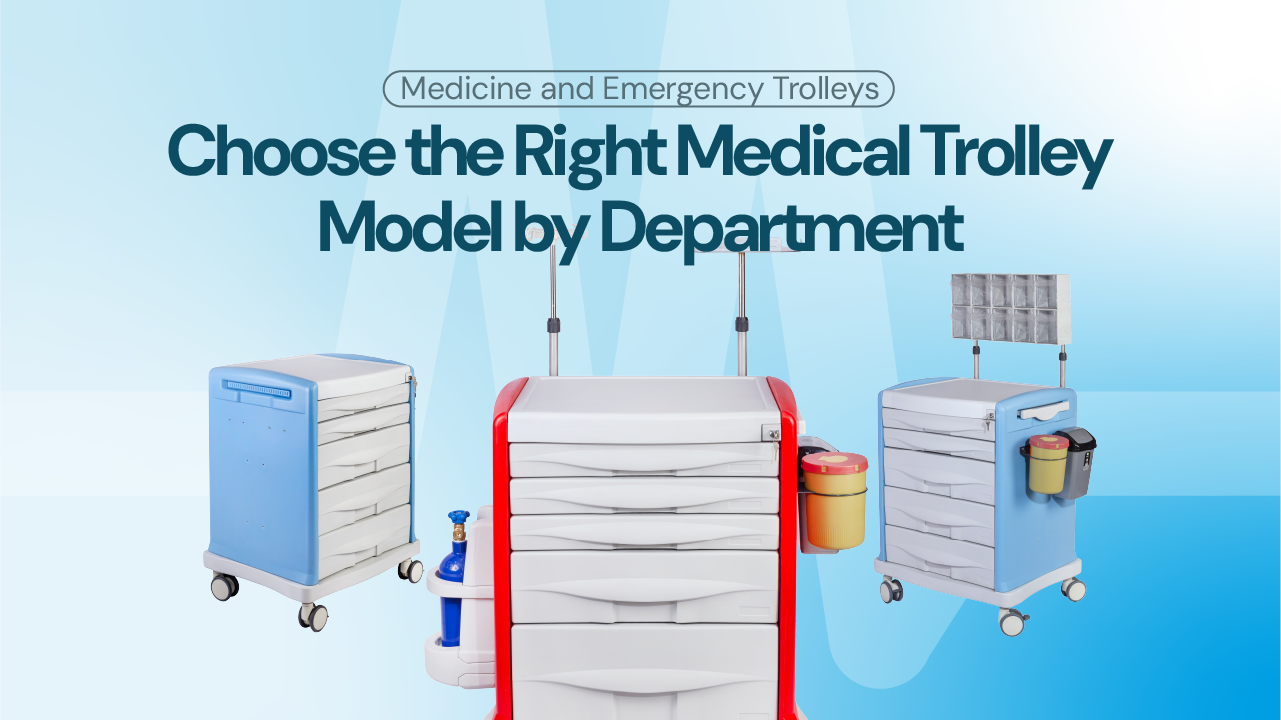
When the right hospital medical trolley is not selected, the problem usually arises after delivery: the ordered trolley does not fit the workflow of the department. Drawers are insufficient, wheels get stuck in the corridor, the surface does not withstand chemicals. This is mostly not a product problem; it is a selection error caused by not asking the right questions in advance.
This guide offers you three concrete benefits: you will be able to distinguish between different types of medical trolleys, determine the correct configuration according to your department, and know what to write in the technical specifications. As Meyosis Hospital Equipment, we have prepared this guide based on our field-gathered experiences and the common selection mistakes clinics make. Our approach is direct and practical: not with theory, but with knowledge that works in the corridor.
To Choose the Right Trolley, First Know the Types
When you say “medical equipment trolley” in a hospital, you might actually be referring to four distinctly different trolleys. Each has a different internal layout, equipment, and speed priority. Ordering without knowing this difference results in a product that does not match the department’s needs.
Emergency Resuscitation Trolley: Seconds Are Critical
The emergency resuscitation trolley is designed for speed. A defibrillator space, CPR board, oxygen cylinder holder, and IV pole constitute the standard equipment of this trolley. A 5-drawer structure is generally preferred; drawers are organized by categories: airway supplies, IV access equipment, emergency medications, consumables, and pediatric/specialty sets. It has a locking system. Emergency access is always the priority. Accessory rails and a waste bin are standard components.
Medication Distribution Trolley and Dressing Trolley
In a medication trolley, accuracy and safety are the priorities, not speed. Lockable drawers, compartmentalized interior layouts, and controlled access mechanisms are the defining features of this type. A dressing trolley, on the other hand, usually comes in a compact 3-drawer structure; it offers a flat surface for material organization and sterile work. These two types are often confused with each other. The difference lies in the access logic and drawer interior layout: one is designed for control and inspection, the other for rapid deployment to the field.
EMR Trolley and Special Purpose Trolleys
In trolleys carrying computers or screens, the technology infrastructure comes before everything else: battery capacity, cable management, and screen holder determine the design of these trolleys. Sterile supply trolleys and instrument trolleys are separate categories; putting them under the same specifications as general medical department trolleys ruins the functionality of both product groups.
Hospital Medical Trolley Material Selection: Not Every Surface Suits the Same Conditions
Which department the trolley will be used in directly determines the body material. Disinfection load, mechanical impact frequency, and budget constraints are the main variables that shape this decision.
Stainless Steel: The Reference Choice for Busy Departments
Its non-porous surface structure and compatibility with aggressive disinfectants make stainless steel the first choice in intensive care, operating rooms, and emergency departments. It is the option with the highest mechanical durability and is generally advantageous in terms of long-term total cost of ownership. Specifying it as AISI 304 grade in technical specifications prevents quality inconsistencies from the start; the thickness value should be determined according to the institution’s usage intensity and product features.
Polymer: Lightness and Practicality
Properly formulated polymers reduce microorganism adhesion thanks to their non-porous surface and provide an advantage over stainless steel in terms of maneuverability. However, polymer quality varies greatly depending on the manufacturer; low-quality formulations deteriorate in a short time. Prefer them limitedly in environments requiring heavy loads and intensive chemical disinfection.
Painted Metal: Risks to Be Aware Of
It provides an acceptable surface when the paint layer remains intact. When peeling begins as a result of impact and frequent wiping, infection control rapidly deteriorates; damaged areas become much more suitable for harboring microorganisms. The low initial cost is often offset by maintenance expenses in the medium term.
Hospital Medical Trolley Configuration: Technical Details Make a Difference
The technical parameters that most directly affect the purchasing decision are discussed in this section. The number of drawers, their size, and internal layout should be designed according to the department workflow; there is no universally valid standard configuration.
Drawer Count, Size, and Internal Layout
3 to 5 drawers is a common range in general treatment and medication trolleys; 5 drawers have become almost standard in emergency trolleys. Drawer height is critical: shallow drawers should be preferred for small consumables, and deep drawers for large equipment. Internal compartments with separators preserve material organization and reduce material sliding during rounds. Situations requiring lockable drawers are: controlled medications, anesthesia supplies, and valuable consumable products.
Castor and Brake Features
The common structure in the industry includes 4 swivel castors; at least 2 of these must have brakes. The castor diameter is usually chosen between 100 and 125 mm; small diameters are suitable for narrow corridors, while large diameters are preferred for rough floor transitions. Single-brake models fall short in busy departments; a dual brake lock is required so the trolley does not slide unintentionally during use. An anti-static and silent castor option provides an additional advantage, especially in intensive care units.
Modular Design: Why Is It Important?
Fixed-configuration trolleys become dysfunctional as the department’s needs change. Meyosis Hospital Equipment’s modular medical trolleys directly solve this problem: the number of drawers, height, and internal compartment layout can be configured according to department requirements at the order stage. Each configuration is produced under the same quality standard; this is a serious advantage in terms of traceability in large-scale purchases. Working directly with the manufacturer eliminates the intermediary, providing technical customization flexibility and shorter delivery times.
Hospital Medical Trolley Matching Guide by Department
The three most frequently mentioned categories in public procurement catalogs in Turkey are medication trolleys, dressing trolleys, and emergency resuscitation trolleys. However, the question of which one is suitable for which department is often not asked enough.
Intensive Care and Emergency Department
Speed is the primary priority in the emergency department: a crash trolley structure, 125 mm castors, 5 drawers, and a high-capacity durable body are the recommended features for this department; models offering a carrying capacity of up to 200 kg are mostly preferred. In intensive care, a stainless steel surface is overwhelmingly preferred; an IV pole and defibrillator space should be standard. Painted metal or low-capacity polymer bodies are not recommended in these departments.
Operating Room, Polyclinic, and General Clinics
Instrument trolleys are at the forefront in the operating room: a flat and sterile working surface, few drawers, and easy sterilization are the defining features of this type. Medication and dressing trolleys are more suitable in polyclinics: 3 to 4 drawers, medium size, a locking system, and lightness are the prominent criteria. Compact and multi-purpose trolleys can be preferred in general clinics; a modular configuration provides flexibility during department changes, preventing you from having to buy a new product.
Purchasing Checklist: Specifications, Warranty, Spare Parts
The supply contract largely determines how the trolley will perform after delivery. Every item not written in the specifications carries the risk of turning into a source of dispute after delivery.
Items That Should Be in the Technical Specifications
If your specifications cover the following elements, your negotiation process with the supplier will be on a much more solid footing:
- Body material and thickness (e.g., AISI 304 stainless steel; thickness should be determined according to the institution’s usage requirements)
- Number of drawers, internal net dimensions, compartment structure, and lock type
- Castor diameter, number of braked castors, and total load capacity (kg)
- Surface coating type and disinfectant compatibility declaration
- Additional equipment such as accessory rails, IV pole, and waste bin
- Manufacturer quality certificate information (e.g., ISO-9001 and ISO-13485)
Warranty, Spare Parts, and Delivery Conditions
In public hospital procurements in Turkey, the warranty period is mostly determined as at least 2 years; post-warranty maintenance-repair support for products that qualify as medical devices can be requested for up to 10 years. Explicitly write in the specifications whether the spare parts are original or compatible, the supply time, and the pricing method. Whether transportation, assembly, and testing expenses are included in the price must be finalized before delivery; otherwise, these items become a topic of discussion at the end of the contract. Applying the unit price basis in bulk purchases helps prevent pricing disputes from the start throughout the contract period.
Conclusion
Choosing the right hospital medical trolley is a much more comprehensive process than looking at a product catalog. A decision made without understanding the department’s workflow, the disinfection load the trolley will be exposed to, and the long-term maintenance cost lays the groundwork for serious operational problems after delivery.
The trolley types, material properties, drawer configurations, and purchasing criteria discussed in this guide offer a concrete starting point when writing specifications or negotiating with a supplier. When you turn to modular and customizable designs, you are talking about a medical supply trolley tailored to the actual needs of the department, not a standard trolley.
As Meyosis Hospital Equipment, we offer direct support regarding configuration selection: you can contact our team to determine which medical department trolley is right for which department, to create the specifications together, and to make our quality-assured production process work for you. Reflecting this difference in your specifications turns into a long-term gain for clinicians and hospital management.